
PRACTICAL GUIDE · UPDATED 2026-10-30
Heating controls: comfort, timing and safer efficiency changes
Learn what each control changes before adjusting it, especially where the boiler also heats a hot-water cylinder.
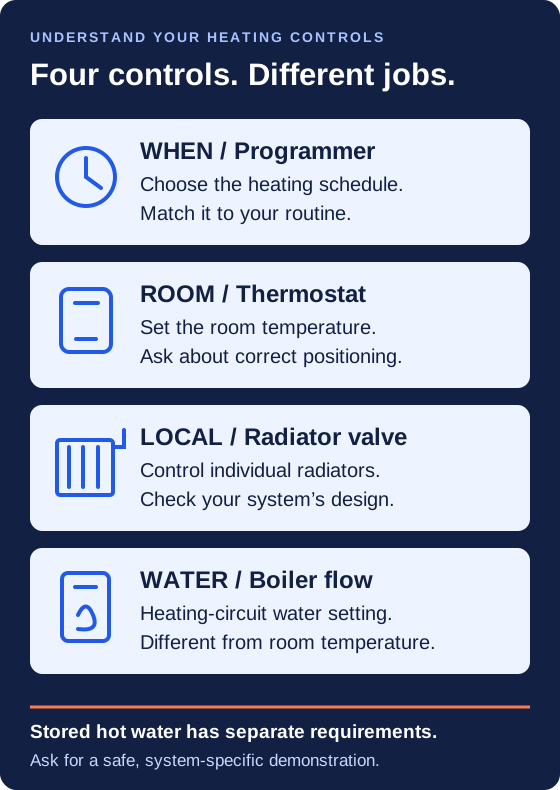
A programmer sets heating times; a room thermostat sets the desired room temperature; thermostatic radiator valves (TRVs) limit individual room temperatures. A cylinder thermostat controls stored hot water. Start by checking schedules against your routine and using comfortable settings appropriate to the household's health. Turning a room thermostat much higher does not make the home warm faster. Keep radiators and their sensors free from obstructing furniture or curtains.
Boiler flow temperature is the temperature of water sent into the heating circuit, not the room thermostat setting or necessarily the tap-water setting. In a condensing boiler, a lower return-water temperature helps recover more heat from the flue gases. Where the appliance manual allows a separate radiator setting, a careful reduction may improve efficiency, provided every room still heats adequately. Warm-up can take longer and colder weather may need a different setting. Use only the normal user controls described in the manual; do not remove boiler covers.
Do not apply a universal radiator flow-temperature tip to a system that also heats a cylinder. Some boilers use a shared setting for both tasks, and the water supplying the cylinder must be hot enough to achieve its safe storage temperature. Lowering that setting indiscriminately can compromise hot-water hygiene. Legionella protection, any scheduled high-temperature cycle and scald prevention need system-specific advice from a qualified installer. Do not disable a disinfection programme, safety control or immersion backup that forms part of that protection.
Weather compensation adjusts heating-water temperature with outdoor conditions; load compensation responds to indoor demand. Compatibility and commissioning matter. Heat pumps generally work well with longer, steadier heating and modest setbacks rather than repeated short bursts. Ask the installer to explain the heating curve, minimum flow requirements and interaction with TRVs before changing settings. A schedule suitable for a gas boiler is not automatically efficient for a heat pump.
Smart controls can make scheduling and remote adjustment easier, but buying an app-controlled thermostat does not guarantee savings. Ask what it improves over your existing controls and whether it supports the appliance's efficient control functions. If rooms remain unevenly heated, request a site assessment for control faults, balancing and radiator suitability, with an exact quote before work. Electrical changes and gas work belong with suitably qualified tradespeople.
Your checklist
- Identify room, radiator, boiler-flow and hot-water controls separately.
- Check the manual before changing normal user settings.
- Keep safe warmth, hot-water hygiene and frost protection in the plan.
- Have cylinder-related settings and heat-pump control changes checked when unsure.
Sources & further reading
- Energy Saving Trust: Heating controls ↗
- Energy Saving Trust: Should I turn my boiler's flow temperature down? ↗
- Energy Saving Trust: The most efficient way to run a heat pump ↗
- HSE: Legionella and domestic hot-water control measures ↗
- HSE: Gas safety for homeowners ↗
General information, not a property assessment, booking or assurance about a listed business. Dates indicate content updates; they are not invented publication dates.